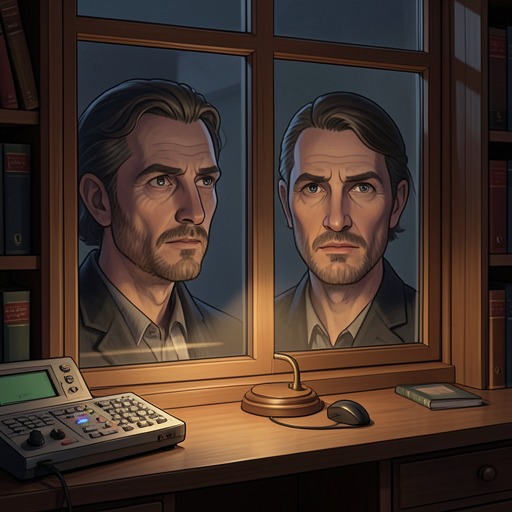
Two young men lost in the woods
I Know This Much Is TrueThe expression “Two young men lost in the woods” is the turning point in a therapeutic metaphor: what first sounds like a search for one missing young man becomes a recognition that both brothers are lost, though in different ways. Its significance lies in this double vision. Thomas may be the brother whose crisis prompted the search, but Dominick is not merely the person looking for him; he, too, needs to be found.
The search on foot
The image first appears as a description of how to understand a young man who, at nineteen, walked into the woods and became lost. The speaker presents the work not as a confident diagnosis or a guaranteed rescue, but as an attempt to make a fuller picture. Rather than analyzing data from above in helicopters, the searcher goes on foot, calls the young man’s name, and listens for a response. The contrast makes the method deliberately modest: progress depends on attention to a particular person, not on an assurance that the search will succeed.
The metaphor also gives uncertainty a shape. The speaker cannot promise to find anything helpful, and the process is described as trial and error. The woods stand for a condition whose path out is not yet visible; calling and listening are actions that acknowledge both distance and the possibility of contact. The image therefore treats understanding as something approached through repeated attempts, rather than as information that can be collected at a remove and converted into an immediate solution.
Dominick’s resistance and the second lost man
Dominick rejects the proposed method as a waste of time. His response marks a conflict between the therapist’s willingness to proceed without guarantees and his own impatience with a process that may not produce a quick, concrete result. The exchange matters because the metaphor does not instantly persuade him. It instead exposes the distance between wanting to help Thomas and accepting the uncertain work required to understand him.
When Dominick insists that he wants to help his brother and asks whether the therapist can learn anything, she reaches for his hand and squeezes it. She says that she has learned something useful: there are two young men lost in the woods, not one. This revision changes the metaphor’s subject. The original image seems to direct attention toward the young man who disappeared into the woods; the second version makes Dominick’s own condition part of the problem. His role is not only to search for Thomas or to provide information about him. He is also a person in need of attention.
The hand squeeze gives the recognition an interpersonal form. The therapist does not answer Dominick’s demand for useful knowledge with a claim that Thomas has been understood or recovered. Instead, she identifies a second person who may be reached through the conversation already taking place. The scene’s movement—from his skepticism, to his stated wish to help, to her physical gesture and revised image—makes the metaphor itself an act of listening: it registers what Dominick has said while recognizing what he has not centered.
Unequal prospects of being found
The two lost men are not presented as equally accessible. The therapist allows that she may never find one of them: he has been gone so long that the odds may be against it. The image preserves the gravity of Thomas’s prolonged absence without claiming that the search has ended or that recovery is impossible. Its language is cautious, matching the earlier refusal to guarantee a helpful result.
For the other young man, she sees a different possibility. He may be calling her. The distinction turns the woods from a single shared predicament into two related but separate forms of lostness: one person may have been unreachable for a long time, while the other is now making contact. The metaphor thus redirects hope without confusing hope with certainty. It does not promise that either brother will simply be led out; it identifies a response that may already be underway.
Meaning within the scene
The expression’s force comes from its revision. At first, the therapist describes a search for one young man; after listening to Dominick, she recognizes two. That shift resists the assumption that the brother who appears more capable of speaking or acting is therefore safe, or that the family’s attention can be confined to the person in crisis. Dominick’s determination to help Thomas coexists with his own need for help, and the metaphor makes that parallel visible without treating the brothers as interchangeable.
The woods also give the exchange a structure of call and response. The searcher calls a name and listens; later, the therapist suggests that one of the lost men may be calling her. Listening is not presented as passive waiting but as the condition that makes a reply perceptible. What changes is not a guaranteed outcome but the listener’s understanding of whom the search concerns. The phrase therefore captures both the limits of therapeutic knowledge and its possibility: one brother may remain difficult to reach, while the other has begun to answer.